
From an FCK rejection to Vila do Conde — a detailed analysis of the Togo U23 international Rio Ave signed from IFK Göteborg
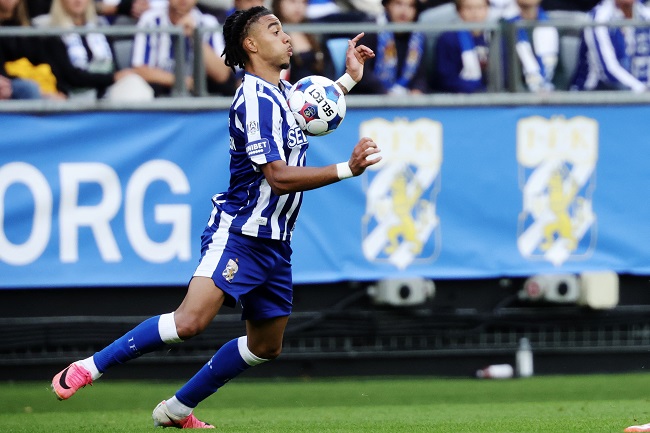
Sebastian Senna Hounou Clemmensen was filtered out of FC København’s academy in 2020, aged 16. That is the ordinary end of most Danish football stories. Copenhagen releases a dozen boys a year, and some of them are never heard from again; others end up in smaller clubs around the Swedish, Danish and Norwegian football pyramids. Clemmensen went two miles across the city to B.93 in Østerbro, a club that has spent most of the last half-century in the lower divisions, and then his knee gave away.
Two operations. Around eighteen months out. He was 17 and 18 during the stretch he lost, the years in which a released academy player is supposed to prove the release was a mistake, and he spent them in rehabilitation at a second-tier club that had taken him on when nobody else would.
Here’s why Rio Ave signed him. Between the injury and his exit, Clemmensen scored 16 goals in 38 league and cup matches for B.93 in the NordicBet Liga. In August 2024, Hammarby paid a reported four million kroner — a little over €500,000 — plus bonuses and sell-on clauses to take him to Stockholm, the largest sale in B.93’s history. He was gracious about it afterward, pointing out that the record cut both ways: the club had backed him when FCK didn’t, and the fee was their reward as much as his. In January 2024, he made his debut for Togo’s under-23s, taking the international route his surname suggests rather than the Danish one on the back of his shirt.
Six months later he was gone again.
Two clubs in six months
Hammarby signed him on a four-and-a-half-year contract, gave him his Allsvenskan debut off the bench against Elfsborg on 22 September 2024, and played him four times in total. On 6 February 2025 they sold him to IFK Göteborg for around seven million kronor, roughly €630,000, and kept a quarter of any future sale — a clause set at more than double the usual ten per cent. Whatever Hammarby concluded about him in those six months, it was not that he was worth nothing. It was that he was worth more somewhere he would actually play, and they just didn’t find the space he needed, so they had to capitalize on the interest.
Göteborg gave him four years and a description. Hannes Stiller, the sporting director, called him mobile, intense, quick and technical, a left-footed forward the club was convinced they could get more out of. The first season read like a player that was still settling in: three goals and one assist in 21 matches. This season, he has three goals and three assists in 15 Allsvenskan matches, and 4+3 in 19 across all competitions. He became a regular starter and one of the most interesting and exciting U23 left-footed talents in the Allsvenskan.
Then Rio Ave came. Fotbollskanalen, citing Expressen, put the offer at around 15 million kronor, about €1.35m. Hammarby’s clause takes a quarter of the whole sum — some €340,000 for four appearances and six months of his time — and leaves Göteborg a little over €1m against the €630,000 they paid. Everyone who has sold Sebastian Clemmensen has made money on him. B.93 set a club record. Hammarby profited on a player they barely used. Göteborg are up roughly €380,000 across eighteen months.
Role in Rio Ave’s tactical plan
He walks into a squad that already has eight forwards. Diogo Bezerra, Tamble Monteiro, Jalen Blesa, Roland Galcík and Dario Spikic were all on the list Rio Ave presented to their members in pre-season. Clemmensen is the ninth, arriving as the Portuguese window closes on 15 September and the season approaches its 5th round of games.
Sotiris Silaidopoulos is in his second year in charge, which nearly didn’t happen. The Greek coach came close to dismissal midway through last season before the results turned, and Alexandrina Cruz made the continuity argument publicly at the club’s anniversary dinner: a year left on the contract, and a project worth carrying on. Rio Ave finished twelfth with 35 points from 32 matches and have three points from their first four this time, with matches against champions Porto and Sporting already done. Silaidopoulos said in pre-season that he needed signings to raise the level, and then that the ones who arrived needed time.
The shape alternates between a 4-2-3-1 and a 4-2-4, and the front line it feeds is already sorted by function. Tamble Monteiro leads it: quick, proactive, and the one who wins the ball in the air. Jalen Blesa plays off him, the more versatile of the two, physical enough to hold his own but able to drift wide, work around the striker and attack the space he leaves, clinical when the chance comes, and comfortable enough one-on-one. Diogo Bezerra takes the left and is the transition outlet — tall, long-legged, dangerous when there’s pitch to run into. Roland Galcík takes the right and does the same job differently: quicker feet than Bezerra, craftier, better in a phone box.
Clemmensen arrives on Galcík’s side, and that isn’t the obstacle it looks like. He’s every bit as technical; what he adds is versatility and a better sense of where to stand in the box. The two are different players, not one being a lesser version of the other, and a squad pushing up the table needs both.
What makes him fit is the direction Silaidopoulos is taking the team. Rio Ave are trying to be more vertical this season, quicker to move the ball forward and more dangerous in transition, and that’s the game in which Clemmensen is worth picking from the right: against a side that leaves space in wide areas, he can take the ball facing forward, come inside on his left and either cross or play the combination.
Where he plays is the first thing to settle, because Göteborg used him in the wide areas as a right and left-winger but has lately also used him as a forward supporting the striker. Across 2025 he was a left-sided player: fourteen of his twenty-four appearances came at left wing or left attacking midfield, and he returned four goals and two assists from 1,376 minutes. This season he moved. Eight of his sixteen appearances and 506 of his 1,043 minutes came on the right, another 277 through the middle, and only 182 on the left. A left-footed player was turned inward, and the return improved: three goals and three assists in 1,043 minutes, a contribution every 174 minutes against one every 229 the year before.
What we see and what the numbers tell us
He is lean and agile at 1.83m, which is tall for a wide attacker who plays the way he does. Quick, technical, and built more like a forward than a winger, without losing the balance that lets him turn in a small space. He isn’t a particularly strong player, but his size and speed give him some leeway, and he can beat defenders purely on good body positioning and agility.
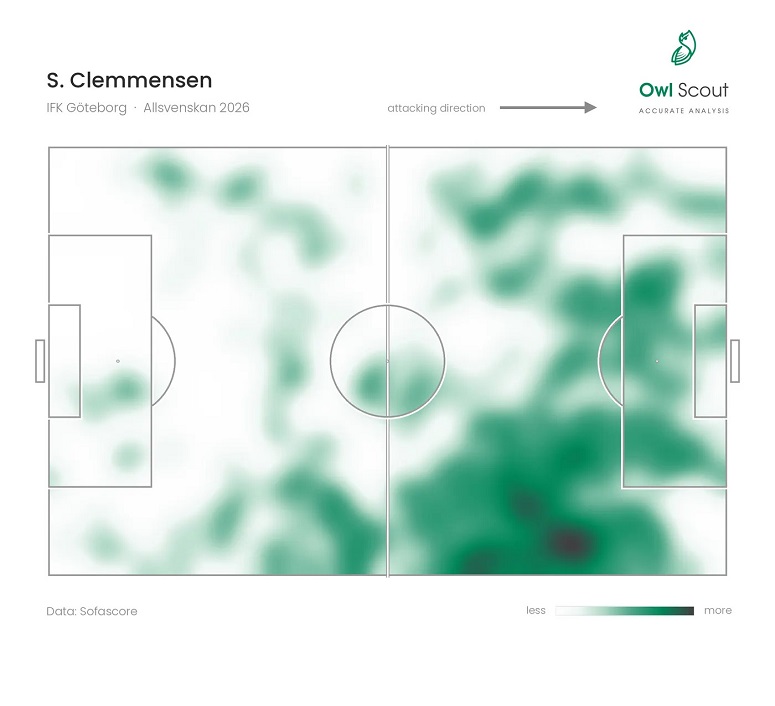
The data says the same thing in its own language. Against the 42 forwards and wide players under 24 in the Allsvenskan with 500 minutes or more, he draws 2.24 fouls per 90, 83rd percentile, and wins 47.3% of his offensive duels, 81st percentile — but he enters fewer of those duels than the median man in the group. He picks his moments rather than running at people, and when he picks one, he tends to come out of it with the ball or a free kick. Where the strength shows is in the air: 30% of his aerial duels won, 36th percentile, at 1.83m.
The first touch is good, and the dribbling is better with room in front of him, but he is not helpless when the space closes. In tight areas, he plays in association rather than trying to beat two men, and that is where the technique shows: he passes with the outside of his boot as easily as with the instep, so the ball leaves him without a backlift and without telling the defender where it’s going. Drifting inside from the right, he crosses accurately and puts an excellent curve on the ball.
That association habit is the strongest thing in his profile. He sits at the 88th percentile for key passes at 0.95 per 90, 86th for deep completed crosses, 79th for expected assists, and for through balls, 74th for passes into the penalty area. For a player his clubs kept describing as a forward, he creates like a winger and always has.
One number cuts against the eye. His crossing completion rate is 32%, mid-table in the group, which is lower than the delivery looks. The curve and the contact are better than the completion rate, and that usually means the ball is good while the timing of the run, or the choice of the moment to hit it, isn’t, and this is something he will need to mature; his decision-making in the final third can improve, and this will impact his career greatly.
He finishes well, and he finishes early. There is power in the shot; he strikes a volley cleanly first time, and he doesn’t take the extra touch to make certain — direct, trigger-happy, occasionally to his own cost.
The shot chart is where “occasionally to his own cost” becomes a number. He took 35 shots this season and hit the target with 25.7% of them, 12th percentile against a group median of 37.8%, while shooting at the 79th. Three goals from 3.43 expected. Twenty of those attempts came from outside the box, and eleven came from corners, which are largely the same shots twice over — his job at a set piece is not to head it, and he took one headed shot all season. He is the player Göteborg stations for the rebound: get to the second ball, finish it if it sits up, win it back if it doesn’t, arrive at the far post if the ball deflects through. That is an assigned role, and it produces exactly this shape of chart: a scatter of attempts around the edge of the area taken early with a defender closing.
Strip those out, and he still shoots from distance more than most. That is simply how he plays, and Rio Ave will take the good with the bad, because the same instinct is what puts him on the end of things. What Silaidopoulos has to manage, rather than coach out, is the moment when the shot from the edge should have been the pass that arrives half a second earlier.
Off the ball, he moves well and reads space. The habit worth noting is what he does immediately after he gives the ball away: he goes into the open space, dragging a defender with him rather than standing to admire the pass. That part of his game makes the players around him better, and it is the part a coach can build a pattern around.
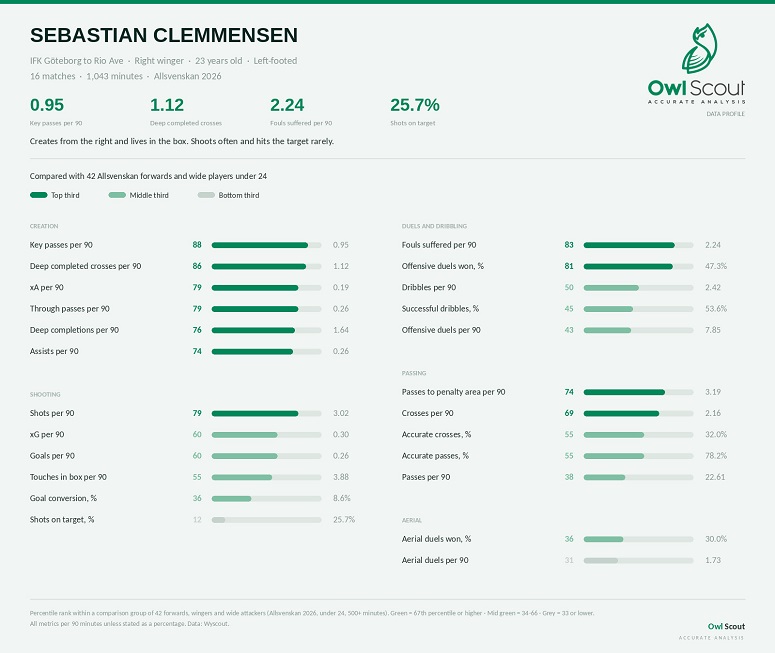
It shows up as a strange pair of numbers. He takes only 40.7 touches per 90, among the fewest in the group, but 5.4 of them come inside the opposition box — one touch in every seven and a half. The heat map agrees: the weight sits in the attacking third on his flank, heaviest at the corner of the box and again around the penalty spot, and he doesn’t drift infield hunting the ball. He works one lane and takes his touches at the top of it. He is not a link player and shouldn’t be asked to be one.
There’s room to improve, especially without the ball and in the defensive process. His work rate and his eagerness to press need work, and so does his positioning without possession over a full ninety minutes. He can do the job in spells. Doing it every week, in a side that will spend long periods defending, is the thing that decides whether he starts.
The map complicates that, and not in his favour. There is a second band of activity running the same channel back into his own half, which looks like a winger doing his defensive work — but presence and pressing are different things, and being in the picture is not the same as arriving on the trigger. Göteborg conceded 2.48 goals per 90 with him on the pitch against 1.65 expected. That is a team number rather than his, and Göteborg’s season is not his fault. It points the same way as everything else in this paragraph, and it is the part of the signing Rio Ave should think hardest about.
Bought on the upswing
What Rio Ave are buying is proven, as far as it goes. Clemmensen has been Göteborg’s first-choice winger for eighteen months, forty appearances and almost two full campaigns, with the output rising across them. Hammarby’s four appearances look stranger the longer you sit with them; every club that has actually played him has kept playing him.
The question is level, not reliability. The Allsvenskan is a league where he was among the better young wide players; the Primeira Liga is where Sporting, Benfica and Porto press you for 90 minutes, and where the sides around Rio Ave are organized enough to deny him the half-space he can exploit. He is 23; he turned 23 two days before the announcement, and the contract runs to 2030 — long enough for Rio Ave to afford him a slow first six months, and long enough to be worth real money if the step works.
The route from an FCK release to the Primeira Liga is not one anyone plans for. Clemmensen has taken it as a compliment that he is worth more to each club that sold him than to the club that bought him, which is a strange and unstable kind of compliment. At some point, the pattern has to break, in one direction or the other.
André Lopes is a Lisbon-based football analyst focusing on player scouting and tactical trends in Portuguese football. You can find more of his in-depth work (in Portuguese) at andreglopes.substack.com.
