

Manchester United defender Diogo Dalot sat down with club legend Rio Ferdinand for an extensive interview this week, covering a wide range of topics at Old Trafford.
Dalot, who is the second-longest serving player in the Red Devils ranks after Luke Shaw, has gained a reputation as one of the squad’s more skilled public speakers. While not one of United’s star names, Dalot’s calm demeanour, excellent command of English and affable nature means he is often in-demand for such media duties.
A theme throughout the interview is Dalot’s focus on preparation, which is clearly influenced by his relationship with Cristiano Ronaldo. The pair became international colleagues during the summer of 2021 with Portugal, soon after which Ronaldo rejoined United in a sensational deal towards the end of the window.
After turning down Ferdinand’s offer of a drink at the beginning of the interview, Dalot admitted: “I have coffee every morning. I never drank coffee in my life. When Cristiano came, because he cannot be still in his room for three hours – he has to move – he would text me ‘Kid, let’s go for a chat, let’s go for a walk’ while we were waiting for the games. We would sit, talking. I would have nothing. He had his coffee and would say ‘just try, put milk, whatever..’ Then it became routine. Now…every morning.”
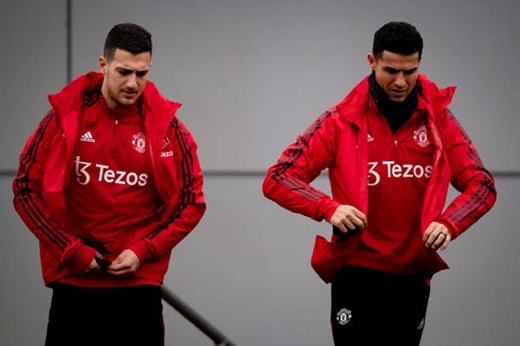 Dalot has spent almost his entire senior career at the club, having joined United as an 18-year-old from FC Porto in 2019, when José Mourinho was manager. During the almost seven years he has been at Old Trafford, Dalot admits to have seen almost complete change at the club, but nothing was more transformative for him on a personal level than Ronaldo’s arrival.
“Meeting Cristiano was career changing,” he says. “I thought I was professional, I thought I was okay in that department. But he took me to another level. Because once you’re with him every single day, you understand. The energy he has can be passed to you really easy. I remember the first few chats we had, I said I wanted to be here but I don’t know [if I have a future] …he said to stay. That confidence straight away put in my mind that this time I’m going to spend with him I’ll enjoy 100%.
“It’s an opportunity not many players had. Seeing him every day was life changing for me. The consistency that he had was what impressed me the most. Putting that into my life and my career changed me.
“We would come into Carrington in the morning. We’d do breakfast. I’m okay, I feel fine physically. He’d say ‘let’s go to the gym to do preparation’ and I’d say ‘Cris, you feel you need to? He’d say yes, not matter what. We’d go to the gym, 30 minutes before everyone. Little bit of bike, talking about things. No matter the circumstances, we would be there. Same time.
“After training, he would want to go do his stretching in the gym. ‘But Cris, do you feel like you need a stretch?’… ‘I don’t care…I have to do it’ Sometimes it’s not just because he needs it, it’s that discipline he has that no matter the situation, you need to do it. And I brought that into being a little more consistent recovery-wise. Sometimes players think just on performance, not health. The cycle is that if you take care of your health, performance will come after.”
 “Amorim was very important in United’s history”
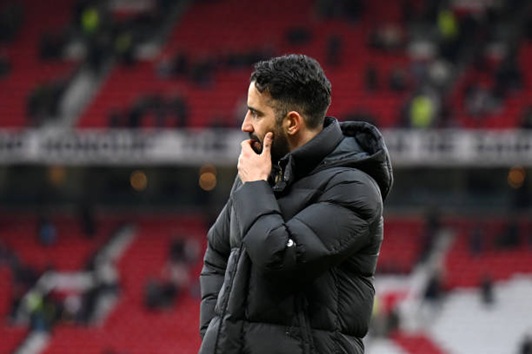
Such habits are useful for Dalot, given he is considered one of the more influential dressing room figures at the club. Ruben Amorim appointed his fellow Portuguese as one of the six members of a ‘leadership group’ aimed at addressing deep-rooted issues surrounding discipline and off-field attention to detail.
Amorim’s sudden departure in January following a breakdown in his relationship with the club hierarchy was a surprise to even his most ardent critics. While few United fans will currently be regretting Amorim’s exit given Michael Carrick’s impressive impact as interim manager, Dalot insists that off-field improvements are down to the former Sporting boss.
“I would look at Ruben as something really, really important in this club’s history,” Dalot says. “I think it’s a little bit bold to say it and people might not believe it, but as soon as he came he changed a lot of things that you don’t see.
“He’s a guy who has to be in a place where there’s discipline, there has to be standards. And he tried to do that straight away, whether you like it or not. And we had to adapt right away. Because I knew what he had done at Sporting, I was a bit more aware of what was going to happen, but I didn’t know him before.
“Obviously, I think what we did on the pitch didn’t work, in terms of results. But I think he created a great group of players that we have now. And if you see the squad that we have now, with three or four really good players from the summer added and helped us make the step up to where we are now, fighting for Champions League places.
“It’s always sad when this happens and I’ve had a lot of moments like this because you’re judged by the results.
Asked by Ferdinand if he would put Amorim’s legacy down to discipline, culture and standards, Dalot replied: “Yeah. I think he tried to implement that straight away when he arrived. Here you don’t have that much time to prove you are good enough to be here unless you win games. Unfortunately, we could not win as much as we wanted.
“The message that I tried to take from that was not that I have to do what he asked or I’m out. No. It was asking you for discipline, standards, giving value to what the team needs; you cannot distance yourself from the team because training will not be as good or the level will drop. Even now, I think because we have been through that as a group and had that experience – if we see something happen, naturally we are saying ‘careful’…even if it’s little things.
“We are not in the military, we’re not in the army. The club gives you everything: nutritionist, psychologist, physical coaches – it gives you everything to succeed. You have your own responsibility. But there are also club rules; things you need to follow because it’s what the club demands.”
Full-back more comfortable than wing-back
Having praised Amorim for some of the less obvious benefits of his tenure, Dalot concedes that the formation switch back to a familiar 4-3-3 under Carrick is more comfortable for his game. A criticism of Amorim throughout his spell at Old Trafford was a persistence with his favoured 3-4-2-1 which had yielded so much success at Sporting, but seemed to hamper certain members of the United first team.
“The biggest difference is when you play as a full-back in the back four, you always have the winger ahead of you. And obviously when you play in a position you played your whole life, you feel a bit more comfortable. I didn’t remember the last time I played two or three games in a row as a right-back in a back four.
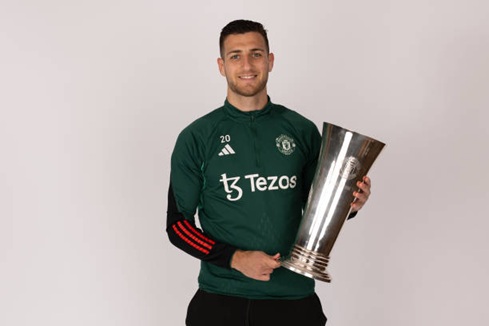 “It was something I had to learn and adapt to also. I also had to play left-back a lot in the last couple of years because we had a lot of injuries. If you ask me to play wing-back for 50 games, I can play. Am I going to be the best left wing-back in the world? I don’t know, I will try, but probably not. If you ask me to be the right-back, I can compete. That I know.
“What I would say, the other part is it brings you other things, playing in other positions. That is one of the things I will never refuse. I don’t like to say no, I don’t like people to think I cannot do it. I will try. I remember with Ten Hag in build-up I played 6 with Casemiro by my side. In training I asked him [Casemiro] about body shape and touches, and he gave me feedback constantly.
“Now if I have to go into midfield, I’m calmer. Because in the midfield you have to think fast. That’s how I look at it. But of course if you ask me where I feel more comfortable, I will say right-back is my position and where I think I can be one of the best. But I’ll never say no to playing in another position.”
United have won four and drawn one from their five Premier League matches under Carrick – a run of form never achieved with Amorim. Many have put the upturn in results down to Carrick, who spent 12 highly successful years at the club, simplifying instructions and drawing more confidence from the players.
“Carrick’s biggest advantage is him knowing exactly what it is to play for Man United,” Dalot suggests. “What it is to be around Carrington, what the people need from you, what the fans expect from you, what is type of game it will be. One of his biggest strengths is the balance he has: he will never be too high, he will never be too low.
“When he came he knew exactly what to say to us. Key messages, how to play, one or two things we need to be aware of in the game. And then just play the game. That’s been how we’ve been the last couple of games and we’ve been fortunate enough to be better than we’d been playing before.”
Criticism? I won’t be a victim
Dalot was named United’s Players’ Player of the Year back in 2024 under Dutch boss Erik ten Hag, but has often borne the brunt of criticism since, particularly during Amorim’s spell. The occasional ire directed at Dalot feels harsh given his unwavering level of application on the field, while often finding himself out of position was an added hindrance, but the Porto native refuses to be affected by the doubters.
“It became a bit more difficult because of everything that is happening online. Everyone can say whatever they want. Unless you live in a cave, you’re going to be aware of what is being said. But to be honest, my professional career has all been here so I’ve had to learn how to balance that and how to deal with it.
“How? What I always say and try to pass to my teammates is: as long as I wear this shirt, I will not hide and I will not play the victim. People will talk about you every single week, and if you play well they will say you played well. If we lose a game I will be there [visible] and now I have more responsibility as one of the leaders, I think that’s my responsibility also.”
Captaincy honour
Dalot’s personality not only convinced Amorim to install him as part of his leadership group, it also led to the 26-year-old being named United captain for the first time in December. With Bruno Fernandes absent, Dalot was selected to wear the armband for the trip to Aston Villa just before Christmas, which United harshly lost 2-1 despite a credible performance.
“I cannot lie, it was a really proud moment for me,” he says. “In that moment I couldn’t think what was happening. But in the end of the game, when I arrived home and saw my wife, my father especially, because my father since I was six years old was with me. He looked at me and said ‘you wore the armband of Manchester United!’
“It’s just a proud moment. It’s not easy, they don’t give it to you just because. If you look through the club’s history, I’ve seen and met a lot of great captains of the club. So individually, it’s one of the proudest moments I’ve felt being a part of this club.”
 Advice for Mainoo
One of the most hotly-debated topics during Amorim’s 14 months at the helm, alongside the issue of tactical systems, was the sidelining of United youngster Kobbie Mainoo. The talented midfielder was afforded zero starts in the league this season under Amorim by the time he departed in January, which bemused and frustrated many Red Devils fans.
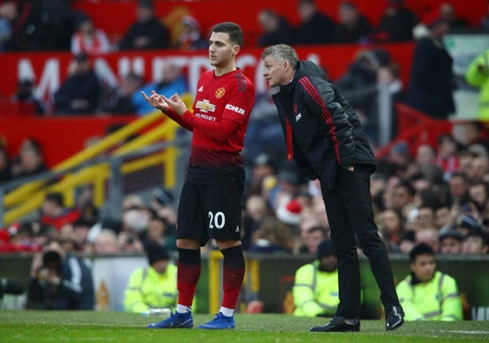
Under Carrick, Mainoo has been immediately redefined as a key player, turning in impressive performances as United embarked on their recent improved form. For Dalot, the situation is a familiar one, drawing memories of struggles to convince Ole Gunnar Solskjaer during his early days at the club.
“It just shows that in football, no matter the manager you have – you have to work the same way,” Dalot insists. “And people might say ‘Diogo, you have had eight managers here’ and yeah, but during these managers I tried always to be the same. And that’s probably why I played a lot of games with pretty much all the managers. Because I worked the same way, I tried to work hard the same way.
“For Kobbie, he could have gone the other way. Because it’s really hard for you at 20 years old, you played 80 games for Man United’s first team, you played for the senior national team, you’ve been there at the top. And all of a sudden, you don’t play. For him to go through that experience, it will benefit him. And I think he feels that.
“He valued training more. It’s like if you ask a guy who’s been injured for a long time, he’s not thinking about playing – he’s thinking about one training session. Let me do one training session, let me do two please, let me do three. If you value those first few steps, when you don’t play it will be easier.
“If you ask me about that situation, I think he will benefit a lot from going through that. In the beginning when I came with Mourinho, I played. Then when Ole came, I didn’t play as much. This period of time was the best period of my career. I had to build my base. And sometimes players think the base is playing all the time. My base was training.
“I didn’t play, I was not an option. I struggled a little with injuries. I came back and I had two or three full-backs in front of me. I had to train, all the time. I always had the confidence that I could play, but in reality I was not going to play. So, my base was in training.
“I will never forget, I don’t know if he remembers, but Carrick [then assistant coach] came to me and said ‘you’re doing everything fine, you’re training well; you just need to keep going, you’re time will come’ It was difficult to understand at the time at 20, but it was the reality.
“I had that period where in one season I had 10 appearances. In these moments, combined with injuries - training was my energy. I was not in the squad, so obviously I was going to the dressing room all the time. I was feeling ashamed of sitting in the stands. I would watch the game in the dressing room on the physio bed. I could not face the people.
“If you check my phone, I don’t have videos of the games at the time, I have videos of training. I would ask the analyst guys to send me the training videos, because that’s how I gained energy. That’s how I looked at it and said ‘you’re going in the right direction’ because I was one of the hardest workers in training. I had those videos, I went home and watched. That was my base.”
 Ten Hag key to confidence
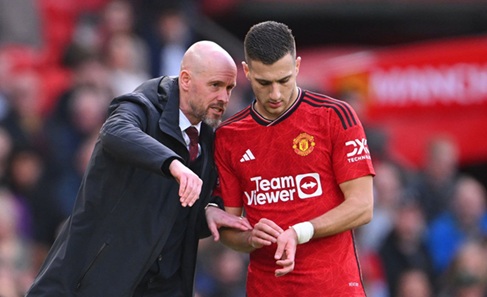
If Dalot always possessed resilience, the period he played under Amorim’s predecessor Erik ten Hag is when he developed the confidence to express himself properly as a United player. Ten Hag may have famously fallen foul of Ronaldo, but it is clear that Dalot holds his time with the Dutchman – during which Dalot won the Players’ Player of the Year after making fifty appearances in 2024 – in high significance for his own development.
“The second season Ten Hag was here, I think I played every game that season. I felt really good, comfortable physically and I was feeling good with the way we played because I felt I was important in and out of possession. It was a season that meant a lot to me. We won the FA Cup. Then the feeling of recognition from your teammates was really important for me, because that’s the people that see you every day and the work you put in.
“It’s a season I’ll remember and set the foundation because I want to be consistent and that year I set a really good level. Hopefully I can combine that with the collective and we can compete.
“Ten Hag saw in me qualities with the ball that no other manager that I’d had previously saw in me. For him to come in and say ‘listen, from the goal kicks you’re going to be a no6, you’ll be alongside Casemiro!’ And I said I like it. All of a sudden I’m training for bounces and having to turn when they’re pressing and finding Bruno in the no10 position.
“He [Ten Hag] was the first one who gave me that responsibility. He knew I could do it before I actually did it. So that trust gave my the confidence to feel important, especially when the team had possession.”
Sesko guidance
Striker Bejamin Sesko has been making a lot of headlines of late at the club following his high-profile move from RB Leipzig last summer. Sesko, who recently scored a vital stoppage-time winner against Fulham and a similarly late equaliser at West Ham, revealed in an interview that Dalot has been the teammate most important in helping him settle at the club.
“What I do every day is try to show how you should behave, how you should be in terms of energy,” Dalot says. “If I do a very good game, you will not see me the next day shouting and smiling – you’ll see me doing the same things. And if we lose and everybody is killing me on social media, you’ll see me do the same things and speak to you the same way. I try to be the same person, that balance.
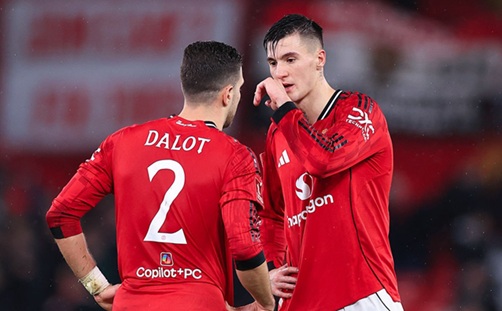 “Ben [Sesko] is one I had a good connection with right away. I saw a lot of myself in him. He will do everything that’s in his control outside the pitch to be ready: physically, mentally. He likes to do everything. But you can overdo it. I told him ‘you know what will happen? You will score one goal and they will say you’re the best, you’re going to be the next one!’ When that happens, I need you to be the same guy the next day.
“Cristiano said to me one day ‘what I’m doing with you now, you will do one day with another player’ That’s why I do it, that’s why I like it, because I can see that he cares. It was natural. With Ben, I have a very good relationship. I spend a lot of time every day at 9am we’re doing work together. These little bits help him to stay balanced.”
Bruno one of the best
Ferdinand inevitably asked Dalot about his countryman and fellow Porto native Bruno Fernandes, who recently celebrated six years at the club, during which time Fernandes has established himself as United’s star man. Dalot feels the subject of Fernandes’ status in English football has become unquestionable.
“I think he was one of – if not the only – player I’ve seen arrive at the club and be pretty much always at the same level. He can be really really good…or really good. He has been very consistent.
“And one of the things that I think is the best attribute which he has is availability. He’s always there, no matter what. Because he’s always there, the pressure is higher. But even in our lowest moments, he helps us. He’s always consistent at a high level and he pushes us. It’s a pleasure to play with players like that.
“I’ve played with a lot of good players here, but Bruno is one of the only ones who stayed and kept consistent. That is really hard in a club like this.
“He’s definitely one of the best players in the league. That’s factual, like it or not. If you cannot see that, it’s because you don’t want it.”
 “We must put United back on top”
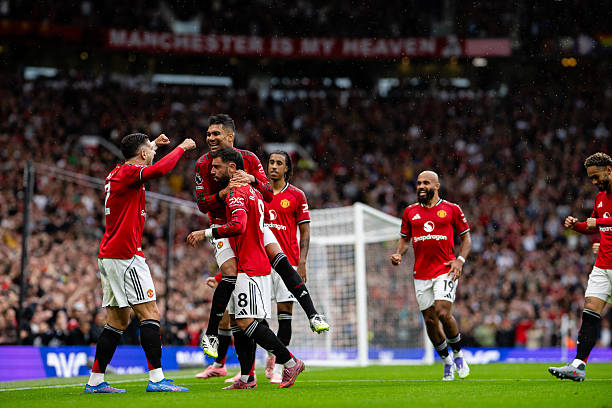
United’s recent form has raised the feeling around the club, but as Dalot is acutely aware, the standards have dropped significantly since the retirement of Alex Ferguson in 2013, since when the club have failed to mount a serious title challenge. Dalot, who admits to have seen wholesale changes during his seven years in Manchester, feels there is great promise in the current side.
“When we won against Arsenal and City, I arrived home and I said to my wife ‘this team is crazy!’ Because we just beat the two best teams in the country from the last two or three years. And we beat them deservedly. They were not on top of us; we controlled the games. We can compete with anybody if we’re like this.
“If I analyse the last seven years, I played five finals. And you’ll say it’s not finals that we want – we want Premier League, we want Champions League. That’s where the club should go. But even in the most tough and difficult years of Man United, we can still play finals, you cans still compete for trophies. That just defines how big this club is and how fortunate we are to play here.
“One of the things I love the most is the energy when you go to Old Trafford. You can’t explain it. If you ask me about it, I say it’s good but if you want the feeling you need to be there. That energy is something you cannot explain and cannot describe.
“I see something here. We have a group of players in my opinion that can go far.
“This responsibility that we have – and one of the things I want the most – is to be a part of the team that puts Manchester United back on top.
“That’s what feeds me.”
(Photos: Getty Images)
