
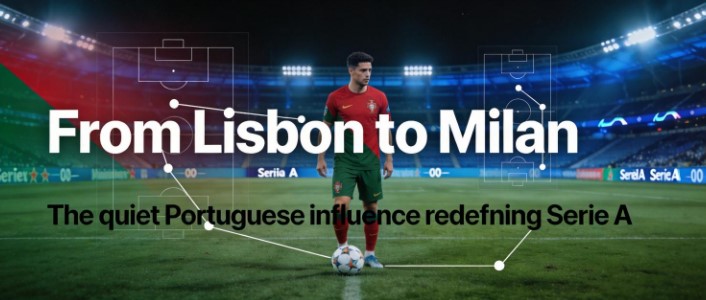
Serie A has always had its own tempo. Slower than the Premier League, more tactical than most, occasionally chaotic but rarely random. Over the past decade, though, something subtle has shifted. Portuguese footballers - and increasingly Portuguese coaches - have begun to influence that rhythm in ways that go beyond simple squad depth. Their presence has affected tactical balance, dressing-room dynamics, recruitment strategies and even how fans abroad follow the Italian game.
It is no coincidence that interest in Italian football from Portugal has grown alongside this trend. Match analysis, performance breakdowns and even markets such as Serie A Odds now attract attention from a broader Lusophone audience, partly because there is a familiar technical signature on the pitch. The connection feels organic. And it has been building quietly.
Why Serie A Attracts Portuguese Footballers
At first glance, the move makes sense from a tactical standpoint. Portuguese players are typically schooled in systems that emphasise positional awareness, structured pressing and disciplined transitions. Serie A, historically, rewards exactly that profile.
The Primeira Liga may not carry the same global weight as Italy’s top division, but in terms of tactical education, it is rigorous. Young Portuguese midfielders grow up understanding the importance of spacing, timing, and defensive shape. In practice, that reduces the cultural shock when they step into Italian football. The demands are similar - perhaps stricter, perhaps slower - yet familiar.
There is also a cultural thread running through this migration. Southern European mentality, shared linguistic roots, comparable media pressure. Adjustments happen, of course, but rarely feel abrupt. Compared to a move to England or Germany, the transition to Italy often appears smoother.
From a recruitment perspective, Italian clubs have long valued intelligent players over purely athletic profiles. Portuguese footballers frequently arrive with strong fundamentals:
- Tactical discipline
- Comfort in possession
- Adaptability across midfield and wide roles
- Experience in European competitions
That combination fits Serie A’s ecosystem almost naturally.
Tactical Impact: Rhythm, Structure and Game Management
Portuguese influence is not loud. It is structural.
Midfielders from Portugal often act as tempo regulators. They are comfortable slowing the game when necessary, retaining possession under pressure, or accelerating play with a vertical pass when the defensive block shifts. That dual capacity matters in Italy, where matches can pivot on a single transition.
Wingers, too, have adapted well. The modern Portuguese wide player is rarely a pure touchline dribbler. Instead, they operate between lines, invert into central areas, or drop into compact defensive shapes when possession is lost. Serie A’s tactical rigidity actually enhances these qualities.
To illustrate the pattern:
|
Attribute |
Impact in Serie A |
|---|---|
|
Positional discipline |
Stabilises defensive transitions |
|
Ball circulation |
Controls match tempo |
|
Tactical flexibility |
Enables formation shifts mid-game |
|
European experience |
Reduces adaptation time |
In our experience analysing Italian matches week after week, these traits translate into subtle control rather than highlight-reel moments. It is about balance. Small corrections. A pass was recycled instead of forced.
That kind of influence reshapes team chemistry. Teammates trust players who keep structure intact. Coaches value those who interpret instructions quickly. And supporters - perhaps without fully articulating it - sense stability.
Coaching Continuity and Philosophical Alignment
The Portuguese footprint extends beyond players. The tactical schooling common in Portugal has parallels with Italian methodology, particularly in defensive organisation and collective pressing triggers.
For deeper context, readers can explore Portuguese coaches in Serie A. That internal analysis highlights how Portuguese managers have navigated the Italian landscape. Their emphasis on structured build-up, compact lines and transitional discipline aligns closely with Serie A traditions. There is friction at times - stylistic nuances always create it - but broadly speaking, the philosophies converse well.
Coaches shape dressing rooms differently from players. They influence recruitment, training tempo, and recovery cycles. When Portuguese staff enter Italian clubs, they often bring a culture of technical precision mixed with adaptability. It does not clash. It blends.
And that blending affects long-term planning.
Recruitment Trends: A Sustainable Pipeline
Italian clubs are pragmatic. Financial constraints have pushed many towards smarter scouting networks rather than blockbuster spending. Portugal has become a fertile ground for that model.
Data from reputable transfer analytics platforms such as Transfermarkt shows a steady increase in player movement between the two leagues over recent seasons. The pattern is not explosive. It is consistent.
Several factors explain why:
- Competitive release clauses in Portugal
- Strong youth academies producing technically polished players
- Familiarity with European tournaments
- Tactical maturity at a relatively young age
Italian sporting directors value predictability. A Portuguese midfielder arriving at 23 or 24 often already understands high-level structure. That reduces risk.
In practical terms, we are witnessing something close to a pipeline. Scouts monitor Primeira Liga fixtures closely. Agents maintain established channels. Negotiations feel routine rather than speculative.
Over time, that continuity influences squad building. Portuguese players are no longer experimental additions. They are integrated pieces in medium-term projects.
Fan Engagement and Cross-League Interest
There is another dimension, often overlooked. Supporters follow players.
When Portuguese footballers perform in Serie A, attention from Portuguese media intensifies. Broadcast discussions reference Italian matches more frequently. Social media engagement crosses borders. In summary, interest expands horizontally.
For Italian clubs, that exposure matters. International fanbases strengthen brand presence. Portuguese supporters, already accustomed to analytical football culture, tend to engage deeply - studying statistics, evaluating performances, debating tactical choices.
That analytical appetite aligns well with Serie A’s evolving identity. The league, once stereotyped as defensively conservative, now blends tactical nuance with increasing tempo. Portuguese profiles reinforce that shift rather than disrupt it.
Al tempo stesso, the narrative works in reverse. Portuguese football culture absorbs lessons from Italy. Defensive organisation, game management under pressure, match pacing - these elements circulate back.
It becomes a dialogue, not a one-way migration.
Chemistry Inside the Dressing Room
Team chemistry is difficult to quantify. It is rarely visible in metrics, yet decisive over a long season.
Portuguese players often integrate smoothly because of linguistic proximity and Mediterranean cultural overlaps. Communication barriers remain manageable. Social adaptation happens faster. That accelerates trust-building within squads.
More importantly, many Portuguese footballers arrive with experience in European tournaments. Facing tactical diversity early in their careers builds resilience. In Serie A - where opponents vary drastically in style from week to week - that resilience becomes valuable.
In short spells, impact may seem moderate. Across an entire campaign, however, consistency emerges. Small improvements in possession retention. Fewer positional errors. Greater discipline when protecting narrow leads.
These details shape results. And results shape narratives.
A Long-Term Influence on Serie A’s Identity
Serie A is evolving. Higher pressing intensity, quicker transitions, broader tactical flexibility. Portuguese talent fits comfortably into that transformation.
The influence is not about domination. It is about integration. A steady infusion of players and coaches trained in a compatible footballing culture gradually adjusts rhythm and expectation.
Over time, this cross-pollination may influence how Italian academies scout profiles, how technical directors prioritise development pathways, and even how supporters interpret match control.
At the end of the day, football identities rarely change overnight. They adapt through accumulated detail - through individuals who carry habits, education and mentality from one context into another.
Portuguese footballers, quietly and consistently, have contributed to that process in Italy. They bring tactical literacy, composure in possession and structural awareness. Serie A, in turn, offers a stage that rewards those qualities.
The rhythm feels familiar now. Perhaps even natural.
And that familiarity suggests the connection between Portugal and Italy is far from temporary.
