
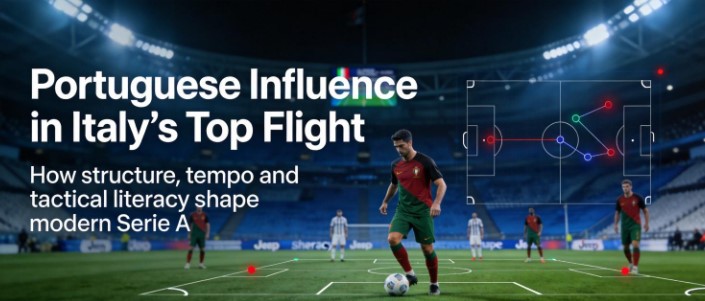
There is a particular rhythm to Serie A. It breathes differently from other leagues - slightly more measured, often more tactical, occasionally explosive without ever feeling chaotic. Over the past few seasons, Portuguese footballers have begun shaping that rhythm in ways that go beyond goals and assists. Their influence is structural. Quiet at times, decisive when it matters.
When analysing Italian matches, whether through tactical breakdowns, performance data or even broader football engagement such as betting, it becomes clear that Portuguese players frequently sit at the centre of key moments. They are not always the loudest presence on the pitch. But they are often the ones adjusting tempo, restoring balance, or accelerating play at precisely the right second.
That detail - that subtle shift in flow - is where their impact truly lies.
Why Portuguese Profiles Fit Serie A So Naturally
Adaptability is the starting point.
Portuguese football education emphasises positional awareness, technical control under pressure and disciplined defensive transitions. Serie A demands exactly that. In practice, the adjustment period for Portuguese players tends to be shorter than for many other profiles arriving from abroad.
The Primeira Liga may differ in pace and financial scale, yet tactically it is rigorous. Midfielders are trained to protect passing lanes. Full-backs understand timing in overlaps. Wingers often develop hybrid roles rather than remaining fixed touchline dribblers.
In Italy, these traits find immediate relevance.
Key characteristics Portuguese players bring into Serie A:
- Tactical discipline without rigidity
- Comfort operating in tight spaces
- Ball retention under structured pressing
- Capacity to interpret multiple systems
It is not about flair alone. In fact, that stereotype misses the point. The modern Portuguese footballer combines creativity with obedience to structure. That blend sits comfortably within Italian tactical culture.
Flow and Discipline: Controlling the Tempo
Tempo in Serie A is rarely constant. Matches stretch and compress, accelerate and slow almost imperceptibly. Portuguese midfielders, in particular, influence that ebb and flow.
A holding midfielder educated in Portugal understands when to recycle possession rather than force a vertical pass. A more advanced playmaker recognises when a defensive block has shifted just enough to exploit a channel. Small decisions. Short passes. A moment’s pause.
Consider the pattern:
|
Attribute |
Impact in Serie A |
|
Positional awareness |
Stabilises defensive transitions |
|
Passing range |
Regulates attacking tempo |
|
Tactical flexibility |
Enables mid-game structural shifts |
|
Decision-making under pressure |
Reduces costly turnovers |
Over ninety minutes, these contributions accumulate. The game feels calmer when Portuguese players anchor the midfield. Defensive lines remain compact. Transitions become cleaner.
In our observation of Serie A’s recent evolution, Portuguese footballers often act as connectors - linking phases of play without drawing constant attention. It is an understated influence, but an enduring one.
Creativity in Decisive Moments
Structure matters, yet Serie A is also shaped by moments of individual brilliance. Portuguese attackers have proven particularly effective in those high-pressure situations.
Wide forwards arriving from Portugal are typically comfortable cutting inside, attacking half-spaces, or drifting between defensive lines. They combine directness with control. When space opens - even briefly - they tend to exploit it.
The example of Rafael Leão remains emblematic. His pace and technical execution have repeatedly tilted tight matches in Milan’s favour. Readers can revisit the broader context in Luka Modric says matchwinner Rafael Leão is “one of the best in the world” as Milan go top of Serie A.
Leão’s profile reflects a wider pattern. Portuguese attackers often thrive in structured environments because their creativity operates within clear tactical frameworks. They are given freedom, yes - but within defined lanes.
That balance between discipline and instinct is rare. And it explains why decisive contributions frequently carry a Portuguese signature.
Recruitment Logic: Why Italian Clubs Look to Portugal
Italian sporting directors are pragmatic. Financial sustainability has become central to long-term planning, which means identifying technically reliable players at competitive valuations.
Portugal offers precisely that market.
According to data trends tracked by Transfermarkt, player movement between Portugal and Italy has remained steady across recent seasons. It is not a short-lived trend; it is structural.
Several factors encourage this flow:
- Competitive transfer fees relative to output
- Strong youth academies producing technically mature players
- Experience in European competitions
- Cultural compatibility within Southern Europe
Italian clubs prioritise players who can integrate without destabilising squad balance. Portuguese footballers tend to arrive tactically prepared, reducing adaptation risk.
D’altro canto, the move benefits the players as well. Serie A provides tactical refinement and exposure at the highest level. The exchange feels mutually reinforcing rather than speculative.
Dressing Room Chemistry and Cultural Fit
Team cohesion rarely receives headlines, yet it influences results across an entire campaign. Portuguese players often integrate smoothly within Italian squads, partly due to linguistic and cultural proximity.
Communication barriers remain manageable. Social adaptation happens naturally. That ease of transition accelerates on-pitch trust.
Moreover, Portuguese football culture emphasises collective responsibility. Defensive effort from attacking players is expected. Midfielders track runners. Full-backs balance ambition with caution. These habits translate effectively into Italian tactical systems.
In tight league races - and Serie A rarely lacks them - consistency proves more valuable than spectacle. Portuguese profiles contribute to that consistency.
Not dramatically. Gradually.
Tactical Cross-Pollination: Identity in Motion
Over time, recurring influences reshape a league’s identity. Serie A has evolved from its historically conservative image toward a more fluid tactical landscape. Higher pressing intensity, quicker transitions, broader positional rotations.
Portuguese players fit seamlessly into that evolution.
Their education encourages versatility. A midfielder may shift between a deep playmaker and an advanced support role. A winger might track back aggressively before launching a counterattack seconds later. These dual responsibilities align with modern Italian expectations.
Al tempo stesso, exposure to Serie A refines Portuguese players further. Defensive discipline tightens. Game management improves. The learning process runs both ways.
What emerges is a hybrid influence - neither purely Portuguese nor purely Italian, but a synthesis shaped by repetition and shared tactical language.
Engagement Beyond the Pitch
As Portuguese presence grows, so does cross-league interest. Supporters in Portugal follow Serie A more closely when familiar faces feature prominently. Media coverage increases. The analytical discussion expands.
This extended engagement also influences how matches are evaluated externally. Performance metrics, tactical breakdowns and match previews increasingly reference Portuguese contributions. Broader football ecosystems - including analytical platforms and markets connected to betting - naturally reflect that interest, given how individual performance shapes match dynamics.
Yet the core remains football. The attraction stems from style and influence, not commercial framing.
A Subtle but Enduring Presence
Portuguese footballers have not transformed Serie A overnight. They have not redefined their identity through sheer volume or spectacle. Instead, they have blended into its fabric - reinforcing structure, adding creativity at key moments, adjusting rhythm in ways that become noticeable only over time.
That subtlety is perhaps the defining feature of their contribution.
Adaptable. Disciplined. Capable of brilliance without destabilising the collective.
Serie A thrives on tactical balance. Portuguese players, in their own measured way, have become part of that equilibrium. And as recruitment channels remain active and cultural compatibility endures, their presence seems likely to persist.
Not loudly. But consistently.
