
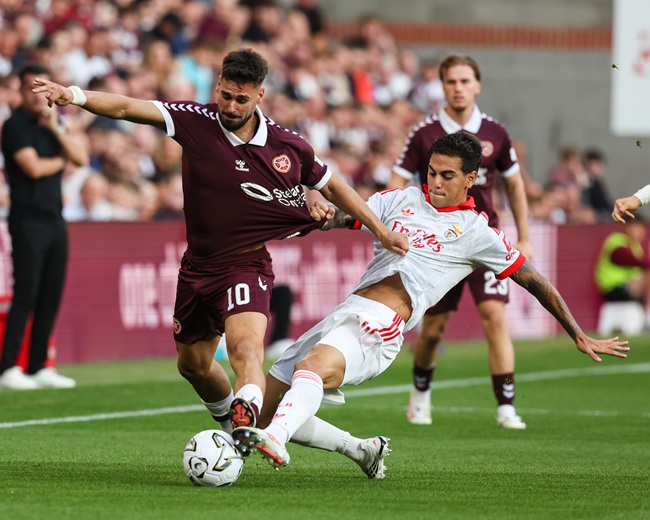
Portuguese coaches, players and sporting directors have spent two decades exporting themselves to every corner of Europe. The obvious destinations get the coverage: England, Spain, France, Italy, increasingly Saudi Arabia and Brazil.
Scotland does not get the coverage, and it probably should, because the Scottish top flight is currently doing something Portuguese football has been trying and failing to do for years.
A league where the duopoly is cracking
The Scottish Premiership has been a two-club competition for most of the modern era, in much the same way the Primeira Liga has been dominated by Porto, Benfica and Sporting.
Last season was different. Hearts inserted themselves into a title race that the Glasgow clubs consider their private property, and the reaction across British football has been a mixture of surprise and delight. It is exactly the shape of story Portuguese supporters recognise from the rare occasions Braga or Vitória have threatened the established order.
Even outside observers have been drawn in. An Arsenal legend has been among those backing the Edinburgh side’s challenge, which is not the sort of attention Scottish football usually attracts from the south.
The structural parallel is exact
Portugal and Scotland share a specific problem, and it is not a lack of talent.
Both are relatively small markets with historically dominant clubs, a substantial gap in revenue between the top two or three and everyone else, and an economic model built on developing players and selling them upward. Both watch their best talent leave in their early twenties, and both have leagues whose competitive balance depends on how well the mid-table clubs recruit from that churn.
The difference is that Portugal has generally treated this as permanent and Scotland, last season at least, produced a counter-example.
What Hearts have actually done
Without over-romanticising it, the mechanics are recognisable to anyone who follows Portuguese football closely.
Recruit efficiently in a market the bigger clubs ignore. Build a defensive structure that makes you difficult to beat rather than exciting to watch. Take points off the teams around you rather than hoping for heroics against the top two. And crucially, keep the squad together for long enough for the shape to become second nature.
That is broadly the Braga model, and it is the model Portuguese clubs outside the big three periodically execute well and then dismantle when the offers arrive in July.
The selling problem is universal
Which brings the parallel to its uncomfortable conclusion.
The genuine test of any challenge from outside a duopoly is not whether it can be sustained for one season. It is whether the club can hold the squad together for a second. Portugal has watched this repeatedly: a side assembles something genuinely competitive, finishes above expectation, and is then dismantled by clubs with five times the revenue.
Scotland faces the same dynamic with an English pyramid immediately south of it that can outbid almost anyone. A successful Hearts season means Championship and Premier League clubs looking closely at players who were unknown eighteen months ago.
Both leagues are, in effect, development competitions that occasionally produce a title race as a by-product.
Portuguese influence is already there
There is a practical connection worth noting too, because Portuguese coaching has been quietly influential in British football for years.
The tactical vocabulary that dominates the modern game in England owes a considerable amount to Portuguese coaching education, and the pathway from the Primeira Liga into British clubs has been well travelled in both directions. Scottish football has taken Portuguese players and coaches for some time, generally without much fanfare.
For a Portuguese player at the wrong end of a squad in Lisbon or Porto, the Scottish league is a more sensible route than it is usually given credit for. European football is genuinely accessible, the standard is higher than the reputation, and the exposure to British scouting networks is significant. Portuguese striker Cláudio Braga has been a major cog in Hearts’ fairytale season, and his career has taken off since his move to Tynecastle Park.
What Portugal could take from it
The lesson is not tactical. It is about competitive balance and what a league is willing to do about it.
Scottish football’s structural problems are real and widely discussed, but a genuine title race from outside the two dominant clubs generates interest, broadcast value and attention that no amount of marketing produces. Portuguese football has periodically had the same opportunity and has generally allowed the moment to pass.
The clubs that break through are not the ones that spend most. They are the ones that recruit precisely, keep a squad together for three seasons, and accept a style that prioritises points over aesthetics.
Worth watching to the end
For neutrals, and for Portuguese supporters in particular, the last few months of the Scottish 2025/26 season were riveting watching.
Not because the standard matches the top European leagues, but because it was a live experiment in whether a well-run club outside a duopoly could actually finish the job. Portugal has asked that question of itself many times and rarely got an encouraging answer.
Hearts ultimately filed to hold on. But the fact they came so close will be studied. It will be filed alongside every other near-miss in a league structured to make near-misses the ceiling. Either way, the mechanics are more relevant to Portuguese football than the distance between Lisbon and Edinburgh suggests.
