
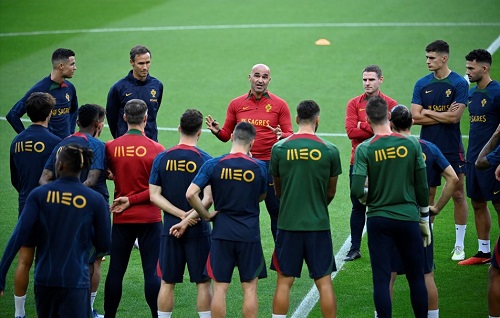
In other words, win the World Cup. (Photo: FPF)
Portugal’s World Cup squad was never likely to be built around shock value. Roberto Martínez announced his 27-man group at the Cidade do Futebol in Oeiras, with Cristiano Ronaldo included for what is set to be his sixth World Cup at the age of 41. Ricardo Velho is also travelling as a fourth goalkeeper, although only 26 players can be formally registered unless injury changes the situation.
The way supporters follow Seleção news has also changed. Squad lists are now debated across live-score apps, podcasts, tactical clips, social media, commercial sports platforms and football-adjacent pages covering sister casino sites. But the central football question is still simple: has Martínez picked a squad that can turn Portugal’s depth into a coherent tournament plan?
Martínez chooses continuity over shock value
The first impression is one of continuity. The right description for the collection would be that it contains no major surprises. This is not a squad designed to make a statement through exclusions or fresh experiments. It is a group shaped by familiarity, positional cover and trust.
There are still talking points. Nélson Semedo’s inclusion stands out because Portugal already have several players capable of operating at right-back, while Samú Costa’s place rewards a strong season at Mallorca and his impressive showing during the March internationals. Gonçalo Guedes also makes the group, which may raise eyebrows given the absence of names such as Pedro Gonçalves, Ricardo Horta, Mateus Fernandes, Paulinho and António Silva.
For a country with Portugal’s player pool, the debate is rarely about whether there is enough quality. The harder question is which type of quality survives tournament football. Martínez appears to have leaned towards players who can adapt quickly, understand his demands and cover more than one tactical scenario.
That may look conservative. It may also be sensible.
Ronaldo remains the question and the reference point
Ronaldo’s presence remains impossible to ignore. At 41, he is still the symbolic centre of Portuguese football and one of the defining figures of the modern game. His inclusion means he is set to appear at a sixth World Cup, an extraordinary personal achievement even by his standards.
The question is no longer whether Ronaldo belongs in Portugal’s history. That argument ended long ago. The question is how Martínez uses him now. He can still provide penalty-box presence, leadership and a clear attacking reference point. But Portugal’s forward line is full of players who thrive on movement, combination play and changing positions.
João Félix, Bruno Fernandes and Bernardo Silva can all operate between the lines. Rafael Leão, Pedro Neto and Francisco Conceição offer width, pace and one-v-one threat. Gonçalo Ramos gives Portugal another central option, while Francisco Trincão arrives after a strong domestic campaign with Sporting.
Ronaldo, then, is both strength and complication. He gives Portugal gravity in the box and authority in the dressing room, but the team must avoid becoming predictable around him. If Martínez can make him a reference point without narrowing the attack, Portugal’s forward depth becomes a serious weapon.
If not, the debate will follow every team sheet.
Versatility looks central to the plan
Martínez’s most revealing explanation concerned versatility. The Portugal coach defended the decision to take four goalkeepers and five full-backs by pointing to the complexity of the tournament, including travel, weather and time-zone demands across the United States, Mexico and Canada. Ricardo Velho is expected to travel as additional cover rather than as part of the final registered 26, unless one of the main goalkeepers suffers an injury.
That explanation matters. This is not a normal European Championship played across a small geographical area. Portugal will need to manage climate, recovery and long-distance movement, as well as opponents with very different profiles. In that context, extra cover becomes less of a luxury and more of a tournament-management decision.
The full-back group is particularly interesting. João Cancelo and Diogo Dalot can both operate in different zones and offer different attacking profiles. Nuno Mendes gives Portugal elite left-sided thrust. Matheus Nunes, although initially a midfielder, has been used at right-back for Manchester City this season, giving Martínez another flexible option.
Portugal’s midfield also suggests adaptability. Vitinha, João Neves, Rúben Neves, Bruno Fernandes, Bernardo Silva and Samú Costa provide different rhythms: control, pressing, creativity, defensive protection and final-third passing. The strongest XI may not always be the most useful XI. Tournament football often rewards the squad that can change shape without losing identity.
That is where Portugal look well equipped.
The Jota “Plus One” gives the squad an emotional layer
Martínez also spoke about Diogo Jota as Portugal’s symbolic “plus one”. The late forward’s memory has been framed as part of the group’s emotional strength, with the coach describing his legacy as something that remains inside the squad.
It is a delicate subject and should not be turned into easy sentiment. But it clearly gives Portugal’s campaign an emotional layer beyond tactics and selection arguments. Jota was admired not only for his goals and movement, but for his professionalism and connection with the national team.
Portugal’s squad is experienced enough to carry expectation. It is also human enough to carry memory.
Supporters will follow every decision closely
Seleção debates are rarely quiet. Ronaldo’s role, the omitted names, the full-back depth, the balance between creators and runners, and the shape of the midfield will all be discussed heavily before the opening match.
Portugal have warm-up matches against Chile at Jamor on 6 June and Nigeria in Leiria on 10 June before travelling to North America. They begin Group K against DR Congo in Houston on 17 June, face Uzbekistan on 23 June, also in Houston, and then meet Colombia in Miami on 27 June.
Those fixtures should give Martínez a final chance to test combinations, manage rhythm and decide how much risk to take with his most experienced names. Portugal are strong enough to carry genuine ambition, but the manager’s challenge is turning individual quality into a stable tournament structure.
The squad has experience. It has versatility. It has attacking variety.
Now Martínez has to make all three work at the same time.
