
Sporting CP may have been the first Portuguese club ever to wear a sponsor in their main shirt, but that was due to a friendly tournament played in Paris. What few know, to this day, is that a much smaller club was the one that took the bold step to embrace modernity and splash the sponsorship of a local company on their kits for an entire season.
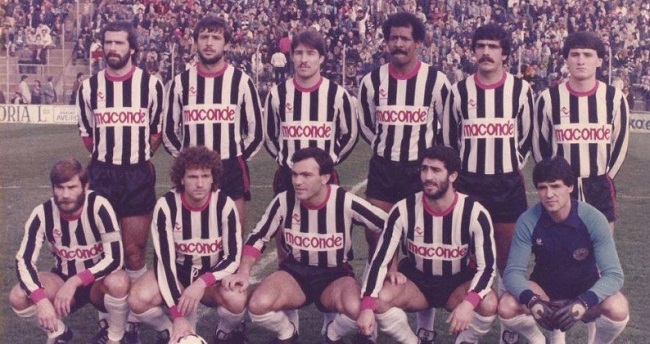
Varzim Sport Club, in 1982, looked like an alien club in a nation that had been living in a dictatorship less than a decade prior. They were pioneers, even if forgotten ones, in making football shirts different from anything anyone had ever seen.
***
Popular seaside resort town
Póvoa de Varzim is a special place. In the summer, the population grows more than fifty percent with tourists coming from all around Portugal to enjoy its beaches. The high concentration of iodine, considered a must for health care, has made the location a popular holiday destination since the 19th century. The resplendent coastline that stretches from the Apulia beaches all the way to the historic rival city of Vila do Conde is amongst one of the most beautiful in Portugal.
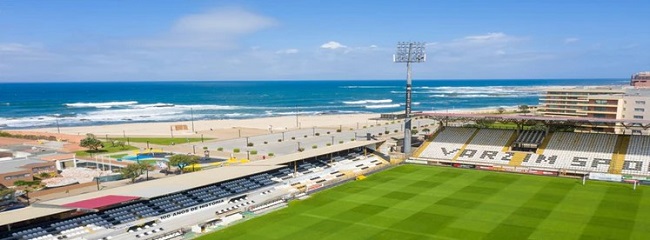
While the locals mostly live from tourism these days, there has also been a small industrial hub ever since the fifties, alongside the famed fishing community, that helped shape their identity. And then there is football. Football has always been a way for the Poveiros to express themselves. Their stadium, one of the most attractive in the region, sits right beside the beach, and their famed black and white striped kit is recognisable anywhere. It’s a special kit as well.
Portuguese football entered a new dimension after the 1974 Carnation Revolution, but it took more than a decade to fully modernise itself. During 1982/83, for instance, FC Porto played with kits made by both Adidas and Puma, often mixing shirts, socks and shorts from both manufacturers, something unthinkable these days. During the season, they would add the sponsorship of Revigres to their shirt, and, because of that, many still believe to this day that the Dragons were pioneers in bringing sponsorship to Portuguese kits. They weren’t.
Local derby hits the top flight
In the summer of 1982, Varzim took a bold step forward. In a quest to find money to invest in the squad, the board decided to follow the example of many European sides of the day and sign a deal with the local industrial manufacturer Maconde. The club had been promoted to the second tier in 1971 – after a short spell in the top flight decades prior – and in 1976, they got promoted once again to the first division. They remained at the top for five seasons before being relegated once again. They only lasted a season in the second tier, bouncing right back up in 1982 at a time when their historical neighbours and rivals Rio Ave were also playing in the first tier, thus making it the first time the famous derby happened in the top flight.
Lídio Marques, the club president, had big plans for the club, which was by then upgrading its stadium and broadening its horizons. José Torres was hired as manager. The former Benfica legend would later become the national head coach on the way to the Mexico World Cup. Conversations between Marques and the company board of Maconde ended with a deal signed for two seasons. Maconde was a local textile company, originally based in Vila do Conde, as chance would have it. They agreed to pay a fee to have their name printed on the club’s home and away shirts as a pioneering step towards a more commercial approach to the game and they even provided the kit material.
It was a time when many clubs from the Ave region were starting to find themselves knocking on the door of the first tier, supported by local businessmen, but until that moment, the support given was almost always pro bono, in exchange for a place on the board. Varzim changed the rules of the game. By paving the way for a local industrial company to garner public awareness of their business through football, they encouraged many other companies in the region that were benefiting from the April revolution and the expected entrance into the European Union, to follow suit to raise their profile. Suddenly, many regional clubs followed the same trend, and by the end of the decade, the districts of Porto and Braga accounted for the vast majority of the clubs in the league.
Maconde a big regional employer
The club’s first shirt design was similar to that used in previous campaigns. Varzim didn’t have a proper shirt manufacturer yet, so the same Maconde, who were to Portuguese textiles in the 1980s what Zara was for Spain – even if their fortunes greatly diverged in the following decades – provided the material as well as the sponsorship. Maconde employed more than 2,000 workers across its four facilities, from Braga to Vila do Conde, Maia, and Póvoa do Varzim, as well as several stores around the country.
The usual black and white vertical strips, slimmer than in previous versions, were accompanied by the usual red collar and the Maconde sponsorship, also in red with a white background. The shorts were also black, while socks were mainly white, even if occasionally the black model was also put to use. The alternative kit was a thing of beauty. An all-black combination of shirt, shorts and socks, only with the lightest white pinstripes and the red collar to go with it. The partnership between the textile company and the club would last until the end of the decade, when Varzim were finally relegated.
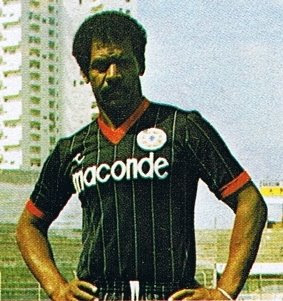
The Brazilian was the father of Bruno Alves and played over 100 games for the club
In the mid-1980s, Varzim were a tough opponent for anyone who visited the seashore ground. With future European Cup winner André patrolling the midfield and Washington Alves in defence, the centre-back who would father Bruno Alves, the side quickly won the affection of many neutral supporters, amazed by the shirt novelty and their no-nonsense approach to the game. The club finished the season 12th in the league, one point clear of relegation and only six points behind Vitória SC, who booked a ticket to the UEFA Cup, just to show how tough the competition was back then.
Champions felled
The highlight of the campaign was a fantastic home win against reigning champions Sporting on the day a new stand was inaugurated. The 2-1 victory proved decisive for Varzim to hold on to their first division status in a season where they also toured Angola, one of the first Portuguese clubs to visit the country during the decade when there was still a civil war raging. They also won their home derby against Rio Ave, a club managed by Félix Mourinho with a young José Mourinho in their ranks, even if they then lost on the away trip to Vila do Conde.
Varzim’s decision was revolutionary. From the following campaign onwards, more clubs started to embrace sponsorship on their shirts, with Sporting the last to join the party in 1987. By then, Varzim had already moved on from their relationship with Maconde and had lost their first division berth. They scarcely ever played in the top flight again, but the Lobos do Mar (Wolves of the Sea) remained a much-endeared club for football fans, and the memories of that futuristic shirt would never be forgotten, even if, for many years, the club didn’t get the recognition it deserved for being one step ahead of everyone else.
By Miguel Lourenço Pereira, author of “Bring Me That Horizon – A Journey to the Soul of Portuguese Football”.
