
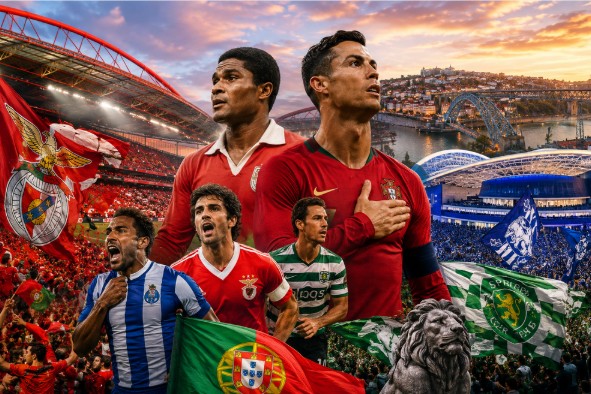
Football is no ordinary game in Portugal. Football is an integral part of the daily routine in the country. People come together to watch matches as families, kids play football on the street, and everyone has their own favourite teams to cheer for. Despite being a small nation, Portugal’s contribution to the world of football is immense. For many fans, football is part of the wider entertainment culture, much like the games and events found at a national casino.
There are numerous legendary players, teams, stadia and rivalries in this history. From Eusébio to Cristiano Ronaldo, there is much to celebrate and discuss long into the night.
How football grew in Portugal
Football in Portugal emerged in the late 19th century. It was a new kind of game, but quickly became popular in Lisbon, Porto and other major cities where new football teams emerged. The popularity of football in Portugal grew exponentially during the first half of the 20th century.
As a result, football became the favourite sport in Portugal. Football clubs gained their fans, and the national team became a source of pride.
Three football clubs played an important part in this story: SL Benfica, FC Porto, and Sporting CP. They are referred to as the “Big Three” of Portuguese football.
The legends who made history
Portugal has produced some of the best football players in history. Eusébio was the country’s first global football star. Known for his speed and powerful shots, he became a Benfica legend. He also helped Portugal finish third at the 1966 World Cup.
Later generations brought more famous names. Luís Figo became one of the best players of his era. Rui Costa was known for his skill and smart play.
Then came Cristiano Ronaldo. He grew up on the island of Madeira and started his senior career at Sporting CP. He later became one of the most famous players in the world. His long career also helped bring more global attention to Portuguese football.
Benfica, Porto and Sporting
The Big Three have dominated Portuguese football for decades. Each club has its own identity and traditions.
Benfica is based in Lisbon and has a huge fan base, that spreads way beyond the capital and also abroad. The club enjoyed major European success in the early 1960s. Its home, Estádio da Luz, is one of the best-known stadiums in the world.
Sporting CP is also from Lisbon. The club is famous for developing young players. Its academy helped nurture superstars such as Cristiano Ronaldo and Luís Figo.
Porto represents Portugal’s second-largest city. The club has also enjoyed great success in Europe. One of its greatest moments came in the José Mourinho in 2003 and 2004, when Porto won the UEFA Cup and the Champions League in successive seasons under the charismatic coach.
Derbies full of passion
Rivalries are an important part of Portuguese football culture. The Lisbon derby between Benfica and Sporting is one of the biggest games of the season. The clubs come from the same city, which makes the rivalry even stronger. Further north, the Minho derby between Braga and Vitória is also a fiery affair bursting with passion
Benfica and Porto also share a famous rivalry. Their games are known as O Clássico. This rivalry is about more than football. It also reflects the historic competition between Lisbon and Porto.
On derby days, fans wear club colours, meet with friends and fill the streets around the stadiums in the backdrop of an atmosphere crackling with tension and excitement. The result can be discussed for days after the final whistle.
Historic moments for Portugal
The national team has had both painful defeats and great victories. The 1966 World Cup was an early high point. Portugal reached the semi-finals, and Eusébio finished as the tournament’s top scorer.
Euro 2004 brought a different story. Portugal hosted the tournament and reached the final, but Greece won the title.
Twelve years later, Portugal finally became European champions. The team beat France in the Euro 2016 final. It was a historic night for Portuguese football and its fans.
Football as a Portuguese tradition
Football in Portugal connects generations. Parents often introduce their children to the club they support, sometimes registering their offspring as paying club members when they are still a baby! Shirts, scarves, songs and match-day habits become family traditions.
Portugal also continues to produce talented young players and skilled coaches. Its clubs have built strong academies and scouting systems. Many young footballers who started in Portugal are now key players in major teams and leagues all over the world.
This mix of history, passion, talent and tradition makes Portuguese football special. Its greatest stories are not only about trophies. They are also about cities, families, rivalries and a shared love of the game.
