
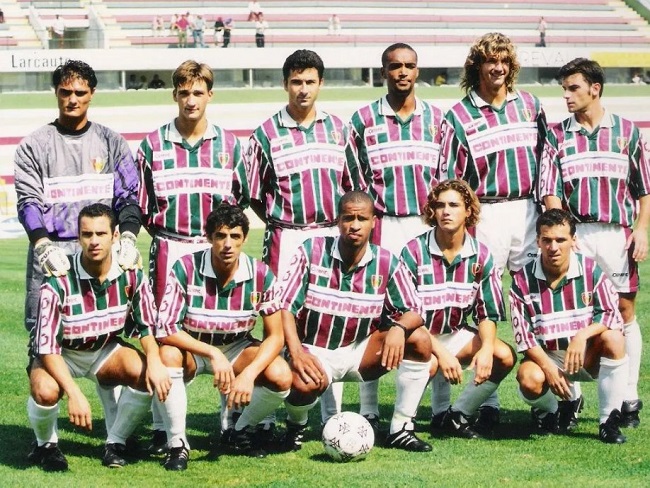
They were back at the very top and it was fabulous. The 1993/94 season was a golden year for the Amadora-based club, which returned to the first division and finished the campaign very close to booking a second European competition appearance after their phenomenal cup win in 1990.
They did all that with one of their most iconic football kits ever, the perfect mix between the club’s colours and their decade-long sponsorship of Continente, which at the time was the most successful chain of hypermarkets in Portugal. A match made in heaven for a season that turned out to be unforgettable at the Reboleira.
***
They are known for their Fluminense-inspired kit, a one-of-a-kind in Portuguese football. The dark red and green, national colours well represented in the flag as well as by the shirts of Lisbon’s top sides, are there, and so is the white trim. The yellow star on the crest makes it the perfect colour combination for any side representing any Portuguese club, for that matter.
Amadora melting pot
And Estrela is the perfect definition of a modern Portugal indeed. The area of Amadora was overloaded with former Portuguese colonists who had lived in Africa for generations and were forced to return after most of the country’s former colonies declared independence. They were resented by the local government, but most had lived there for so long that Portugal was as alien to them as anywhere else in the world. A few years later, civil war and poverty forced mass emigration of the black-skinned population of those said colonies, particularly Cape Verde, Guinea-Bissau, Angola and Mozambique. They found a home in the suburbs of Amadora, and the place became a melting pot of the Portuguese who were originally there, the returning Portuguese from former colonies, known as the retornados, and the Africans from the said colonies who would join them.
It was around those streets that the hip-hop culture started to flourish and that some of the most talented footballers later appeared, but by the 1990s it was just a place full of life, and contrasts were people sought refuge and hoped for a better life in the nearby streets of Lisbon. That appeal was also felt at the local club, Estrela. Unknown to a generation, the football team suddenly started to become more fashionable. The Portuguese Cup win in 1990 was the beginning of something with a side that represented on the pitch the same mixture you could find in the stands of Reboleira. Then, they were relegated and spent the following campaigns in the second tier, without losing their identity. Come the 1993/94 campaign, and here was Estrela back among the big boys, and they came with a kit that represented their spirit to the core.
Hummel partnership bares immediate fruits
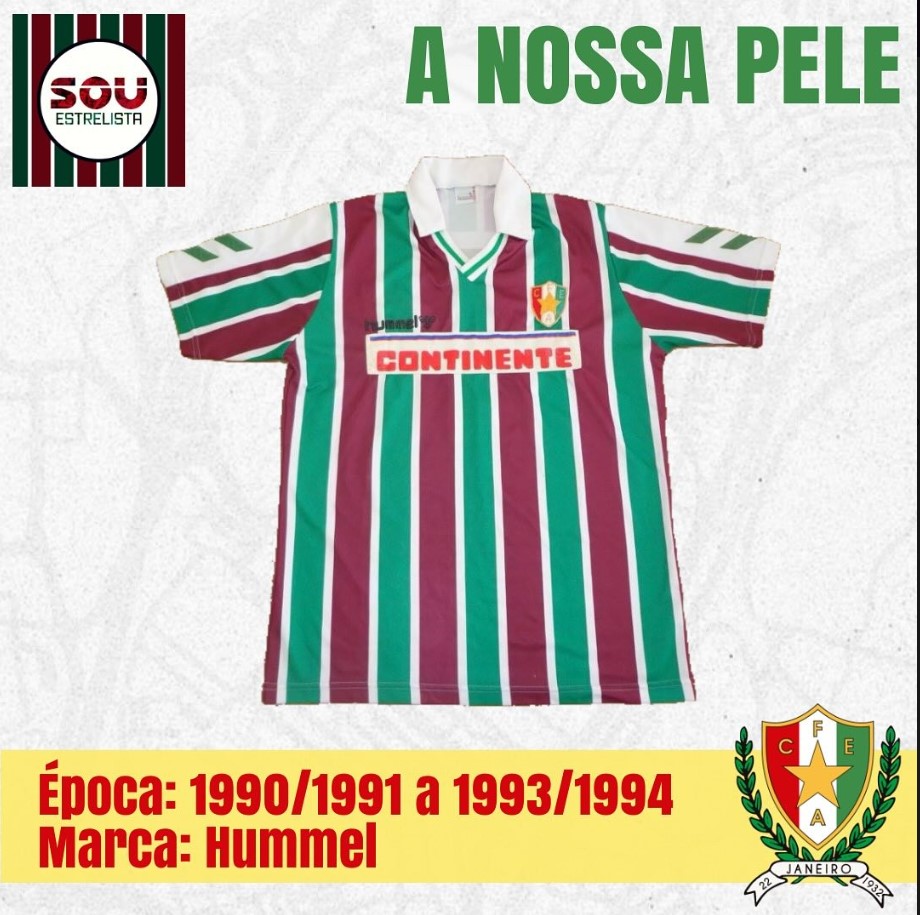
The Estrela template is as old as the football club, and until the late 1980s the kits were made in-house as there was no manufacturer who had shown interest in supporting the club. The cup win changed all that. Soon Estrela signed a contract with the German manufacturers Hummel, and they managed to adapt their flashy and innovative ideas to an already complex template of colours and patterns. By 1993, the club and brand had found their way to make it all work.
The club’s first kit represented the old-fashioned Estrela identity. Five large vertical green stripes followed by four vertical dark red, almost claret, stripes separated by thin white stripes and a huge shoulder line in white where the Hummels logo was placed in green. On the front of the shirt, the all-black logo was less visible, contrary to the club’s crest that deeply resonated with the three colours used on the shirt. No less important was the sponsorship of Continente. The company owned by millionaire Belmiro de Azevedo, one of the most influential industrialists in Portugal, had backed the club since 1988, and they were still there with the famous red logo supported on a white background that covered only a part of the top front shirt, right below the crest and brand logo.
The shorts traditionally were all white with green patterns on the sides, but there was also the green shorts version for certain matches that would demand a change. The year marked the fourth straight collaboration between Hummel and Estrela, and it was possibly the most brilliant kit the German company designed for the Amadora side. The away version was much less interesting, mainly a white shirt with green or white shorts, while the third kit was all red with details in claret and white. They were scarcely used due to the fact that so few clubs used the same pattern as Estrela, although there was always a kit clash with Marítimo during the campaign.
Making a splash in the top division
Estrela’s season was memorable for a club that had spent the previous campaigns in the second division. Coached by former Portuguese international João Alves, the side included the likes of Guy Hubart, an iconic Belgian goalkeeper of the time, as well as centre-backs José Carlos and Frederico, speedy wingbacks such as Fernando Mendes, Rebelo and Fonseca, the upcoming talented midfielder José Calado, later of Benfica, and the veteran midfielders Agatão and Mário Jorge. The attacking line-up included Ricardo Lopes and Fernando, who netted almost 30 goals between them, turning them into one of the most surprising attacking partnerships in the league.
They didn’t start the campaign particularly well, with the first win coming only on the sixth round, against Gil Vicente, but come December things changed. Estrela spent two months unbeaten, including a memorable Cup run that was starting to bring back memories of the 1989/90 campaign. They were eventually beaten by FC Porto on their way to a Cup triumph, but the Dragons had to sweat blood and tears to come out on top. By then the club had already avoided the spectre of relegation and were dreaming of the possibility of fighting for a European place in the league table.
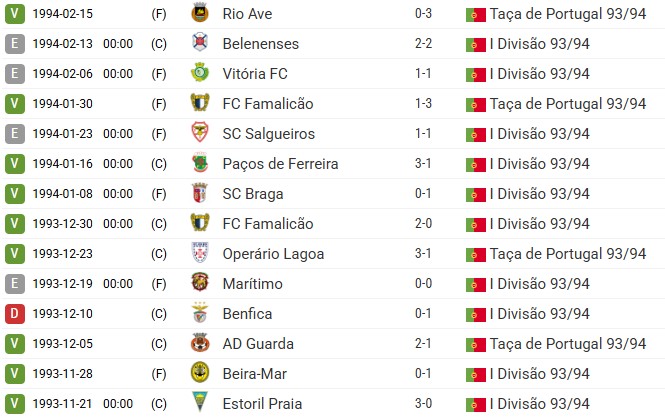
A nil-nil draw against Porto gave them hope, but five straight draws, including against future league champions Benfica, killed their hopes. A win against Famalicão and a draw versus Braga was followed by a defeat versus Paços de Ferreira that closed the shop for them. They ended up beating Salgueiros on the last day of the campaign but remained four points behind Marítimo, who clinched fifth place and the last position that granted a berth in the following season’s UEFA Cup. Estrela finished the league seventh, one point behind Vitória FC, a brilliant result considering they were prime relegation candidates back in September.
Decade at the top
This ended up being the last shirt Hummel designed for the club. The following season the side partnered first with Olympic and then Lotto, brands that enjoyed a brief spell of popularity in Portuguese football in the mid and late 1990s. The next season wasn’t nearly as exciting, as Estrela barely scraped survival on the last day of the season with the help of Vitória FC, who beat União da Madeira, thus allowing the Amadora side to stay in the first division for one more season.
They would then sign Fernando Santos as head coach, who had shown promise with Estoril, becoming one of the toughest away opponents in Portuguese football for the rest of the decade, also fostering talented footballers such as Gaúcho, Jorge Andrade and Chainho. The iconic Continente sponsorship was over by then, as GelPeixe became their main sponsor at the end of the decade, although the same template designed by Hummel years earlier became the customary first choice. A kit that always brings back memories of a time when Amadora was becoming a cult club in Portuguese football.
By Miguel Lourenço Pereira, author of “Bring Me That Horizon – A Journey to the Soul of Portuguese Football”.
